Deuteronomy 6:6-7

And these words that I command you today shall be on your heart. You shall teach them diligently to your children, and shall talk of them when you sit in your house, and when you walk by the way, and when you lie down, and when you rise. ~ Deuteronomy 6:6-7


Friday, May 8, 2020

Fermentools - A Crew Review

Disclaimer: I received a FREE copy of this product through the HOMESCHOOL REVIEW CREW in exchange for my honest review. I was not required to write a positive review nor was I compensated in any other way.


Most of the reviews that I write for The Homeschool Crew feature curriculum, or other educational resources for students. I love them! This particular post is a little different, mostly because it's mainly a product where "I" am the prominent student, yay!  Fermentools sent me their Starter Kit to use and review, and our family has been having fun trying out the food preserving technique known as fermenting.
This has been my first experience with fermenting. I had heard of preserving food through canning, and have dabbled with that a little bit, but that was years ago. Fermenting though, was a mystery to me. Now, having a few mason jars worth of fermented veggies completed, I'm moving past the novice stage, and growing in confidence!
How does the fermentation process work here? Simply put, you want to keep your food submerged under a brine solution (salt water), and unexposed to air, creating an anaerobic environment. This allows the process of lacto-fermentation to take place, resulting in a product rich in those "so good for you" pro-biotics that you frequently hear about. It's a good way to save money, and you can feel better about knowing exactly what is in your food. Side note, it's also really fun! 
The starter kit includes:
- 1 stainless steel lid- made from 304 surgical stainless steel (corrosion resistant)
- 1 glass fermentation weight- fits in a standard wide-mouthed mason jar, and will not react with food
- 1 air lock
- 2 rubber stoppers, 1 with a hole, to use with the airlock, and one solid
- 1 rubber canning gasket
- Himalayan powdered salt
- Instruction guide that includes a basic sauerkraut recipe

This kit is designed for use with a standard, wide-mouthed, glass mason jar.

In the interest of full disclosure, I have to admit that I am typically not a fan of sauerkraut, pickles, and similiar products. However, it's good to try new things, right? Fortunately, my husband and oldest daughter are big fans of those kinds foods, so I knew that at least half of the family would eat the final product, lol.

I had my starter kit, now the next question was, what should I attempt to ferment first? The Fermentools website has a nice recipe section with plenty of ideas, but ultimately, I decided to keep it simple, and give sauerkraut a go. My husband loves to fiddle around in the kitchen, so he was right beside me as we put this together. It's an easy recipe to put together. We had our standard, wide-mouthed mason jar, a head of green cabbage, and our starter kit. It was go time!


We thought that we would start with 1/2 of a green cabbage, as we were only filling one jar. It ended up being the perfect amount, yay! I sliced the cabbage finely with a regular kitchen knife, but you can use a food processor too. Put the cabbage in the bowl, and then sprinkle the Himalayan salt over the cabbage. This is the tricky part of fermenting. It really is a trial and error process, with some guesswork involved. You may have to make a few batches to settle on the amount of saltiness that you ultimately prefer. The recommendation in the directions is between approximately 1 and 1/2 tablespoons of the Fermentools salt (the Himalayan salt) per 5 lbs. of cabbage. For our 1/2 of a head of cabbage, we tried a little over 1 tablespoon.


After adding the salt, you'll use either a potato masher, or your hands, to squeeze the cabbage, which will cause it to release its natural juices. I recommend using your hands. I first tried the masher, and it just didn't do the job. You'll do this for about 10 minutes, until the cabbage is softened, and there is a good amount of liquid.


Next, I put the cabbage in the mason jar, packed it tightly, and added the liquid over it. Then, the glass weight goes on top of the cabbage. The goal is to keep the cabbage, or whatever vegetable being used, under the brine solution.


Now, I finished with the air lock. First, the rubber seal goes on the mason jar, followed by the lid with the hole, where the plastic cannister fits into.  Put the rubber stop that has the hole, securely into the lid's hole.
The cannister has a removable top, and a little removable piece inside. Open it, take the removable piece out, and add unchlorinated water to the fill line. I used filtered water from my Brita pitcher. Put the cannister's top back on, and fit it tightly into the rubber stopper. Let the fermenting commence!
Your sauerkraut or whatever vegetables, need to be kept in a dark, warm place. I wrapped a kitchen towel around my jar, and kept it in an appropriate spot on our kitchen counter. You'll want to leave it to do its thing for anywhere from 3-14 days. We decided on 8 days.


How was the final product? On day 8, we were ready to try it out. According to the instructions, and what they said to look for, we were encouraged. It had the right look and smell. But what about the taste? Well, it tasted like...sauerkraut! Hurray! It was however, pretty salty, so, we actually gave it a rinse under water, which helped. We decided that for the next batch we'll decrease the salt by half. My husband and daughter agreed it was still good though. We celebrated with brats, and piled on the kraut.


I was so happy with the process, that after our general success, I went back to the website and ordered an additional 4 pack kit so that I can make a bunch of veggies at a time. It's fun! We currently have a batch of Giardinara, and a general vegetable mix fermenting away. We'll be trying them this weekend.


We have warm weather, and garden vegetables ready to plant in our gardens. It's a great time to try out this preserving technique. Save money, and improve your health. Give it a try!



Find Fermentools on social media:
Facebook
Instagram
Pinterest
Read more Crew reviews by clicking on the banner below!
Fermentools Starter Kit {Fermentools Reviews}

Monday, May 4, 2020

May The 4th Be With You


It's that time of year again! Star Wars Day! May the 4th be with you! Did you do anything Star Wars-y today? We like the series, although we're not fanatics. My youngest did take the opportunity to watch The Empire Strikes Back. Whatever you did, I hope you had fun!

Sunday, April 26, 2020

Quarantine 2020, Day...I don’t know anymore


This quarantine continues. What’s a person to do? We can start the garden. After a rainy week, today was sunny with temps in the mid 60’s. Sooo, it was a good day to move our seedlings to slightly bigger pots.
We’re trying out some new things this year. I’m the most excited about our artichokes- I’ve been wanting to grow one for years, and this year I finally remembered to get my seeds going early.
We also have petunias, shasta daisies, cosmos, nasturtiums, and a mixed flower collection.
And now...we watch, water, and wait.

Sunday, April 19, 2020

Can You Relate?


Does anyone else feel like this GIF? Feeling completely lost and foggy? Generally, I've been staying positive, but tonight, I'm feeling cranky and fed up with this kooky year. Oh well, this too shall pas, right?

Wednesday, April 15, 2020

Time4Learning - A Crew Review

Disclaimer: I received a FREE copy of this product through the HOMESCHOOL REVIEW CREW in exchange for my honest review. I was not required to write a positive review nor was I compensated in any other way.


It's a great time to be a homeschooler. There has probably been no other point in recent homeschool history where parents taking this educational path have had more opportunities to implement a full and rich curriculum for their children. Still, it can be overwhelming to put a year's worth of material together for a student. How do you know what to choose for every subject? How do you plan out a school year? How do you keep records? How do you handle multiple students in multiple grades? What about teaching for varying learning styles? It can certainly be stressful. Fortunately, Time4Learning has considered these issues, and can help. They were kind enough to provide us with a 6 month subscription to their program use and review, so join me for a few minutes while I tell you about our experience.


Time4Learning is an online program that offers courses for students in PreK all the way through 12th grade. Subjects include:

* LANGUAGE ARTS

- Phonics
- Reading
- Grammar

* MATH
-Elementary Math
-Algebra
-Geometry
-Pre-Calculus
-Trigonometry

* SCIENCE
-Elementary Science
-Earth Science
-Life Science
-Physical Science
-Biology
-Chemistry
-Physics

* SOCIAL STUDIES
-Geography
-Government
-History
-World History

They also offer electives in languages and writing, but we did not review those this time around.


Graphics introduce each activity section.


The lesson without the transcript.


The lesson with the transcript on the left.


My 9th grader has/is using the high school program. I've had her take a look at each subject in order to get an idea for the way each works, but she has focused most of her time on English and Social Studies. The format of the program is great for a range of learning styles. Each lesson in a subject includes fun graphics with audio and music, a video of the teacher that is providing the lecture, and an option to read the transcript of the lecture. My daughter likes that last feature, as it helps her focus and stay on track with a given lesson. There are more than one instructor for each subject, and they switch off every so often.


A history lesson.


She took a cursory glance at the math, which for us was geometry. We already have a current program that we're using, but wanted to check it out. It wasn't a great fit, as my teen found the instructor hard to follow. For example, she would give an instruction and then backtrack because she was correcting herself. Videos and graphics helped underscore the lessons.

We also have a science program that we're using, but looked at Time4Learning's biology course. The teacher was engaging and interesting, incorporating plenty of humor. He reminded me of a favorite science from my own high school days. Again, videos and graphics help reinforce the material.

There are separate log in's for parents and students. There is a good amount of help available for parents on the parent dashboard. You can create lesson plans, reports, and student planners. Also, you have access to one grade above your student's selected level, and one grade below. If you or your child is finding the material too easy or too difficult, you can easily make the switch without any fuss.


Time4Learning costs $30.00/ monthly per student for high school, and $19.95/monthly per student for PreK-8th. What if you don't want to use this program year round? No problem, they offer an option to pause your subscription at any time, and pick it up again when you're ready. The courses are self paced, allowing your student to work ahead or slow down as needed. over all, it offers flexibility.


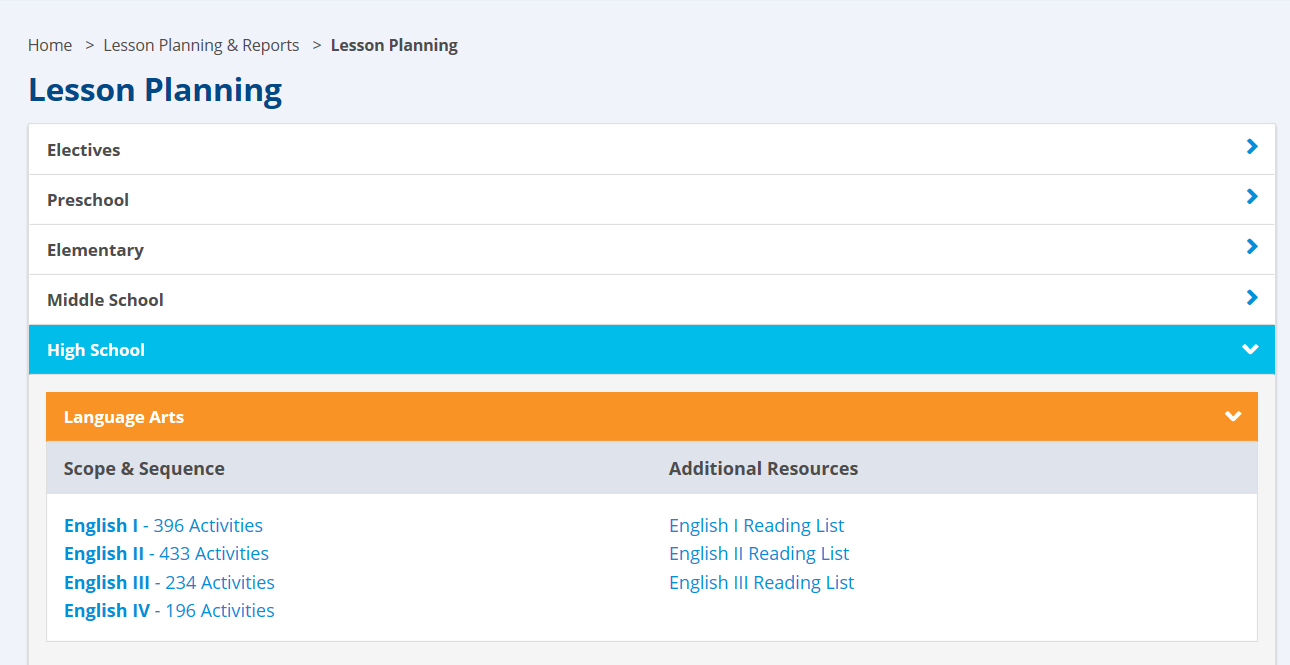
Creating lesson plans is easy by following the prompts and clicking on the sections you need.
Everything is broken down for you.


This is a secular program, not faith based, so there is talk of the Big Bang Theory, Evolution, etc.. That will be good news for some of you, but not so good news for others. A typical lesson will take my teen anywhere from 20 minutes to 45 minutes, depending on the material. There is a lecture, questions, and a quiz. Each activity is marked off in sections, and recorded for your convenience.


What my daughter likes about Time4Learning:

- The introductory video clips and graphics are fun and whimsical, and not just for the elementary grades!
- Lessons are taught with the teacher on screen, but the option to read along with the transcript helps her stay attentive.
- She can work at her own pace, completing more lessons when she wants to work ahead, or take a relaxed pace on other days.
- She likes the overall format, and the flexibility the program provides.

What my daughter doesn't like:

- When taking a quiz, if a question is answered incorrectly, the correct answer is not given, so she doesn't know what the right response is.
- We are a faith based family, and the secular worldview is emphasized.
- The reading selections for English have been a little gruesome for my daughter's preferences.

Will we continue using this program? Yes, most of it. I think that we will continue with the English section, as the layout has been a good fit. We'll also use the history and social studies to supplement our current curriculum. My daughter has found these subjects that she's focused on to be in depth and rich. You can watch some demos on their site, and they offer a 14 day, money back guarantee if you decide it's not for you. Why not give them a try?


Find Time4Learning on social media:


Read more Crew reviews by clicking on the banner below!


PreK-12th grade: math, language arts, science, and social studies. {Time4Learning Reviews}

Sunday, April 12, 2020

Happy Easter 2020!


Happy Easter, He is Risen!

Thursday, April 9, 2020

Sonrise Stable Books - A Crew Review

Disclaimer: I received a FREE COPY of this product through the HOMESCHOOL REVIEW CREW in exchange for my honest review. I was not required to write a positive review nor was I compensated in any other way.


My daughters are polar opposites. They are only about a year and a half apart in age, so you would think that they would have fairly similar interests, right? Nope, not really. While there are some things that they both agree on and enjoy, for the most part, their tastes are miles apart. This extends to each of their approaches to their schoolwork. My oldest could sleep until 10 every morning if I let her, and wouldn't mind not finishing her studies until 4. My youngest, on the other hand, is an early riser who prefers to get her work completed by 1. The differences extend to pretty much every subject. Take history, for example. My oldest approaches the majority of history curriculum with disdain, while my youngest has great enthusiasm for the past. If you find yourself nodding your head in agreement with my situation, stay tuned, because Sonrise Stable Books may be the history resource that you've been waiting for, that will engage even the most turned off students. They provided our family with a copy of History on Horseback: The Early Years to read and review. 


Horses allowed preachers to bring the Gospel all over America.


History on Horseback: The Early Years focuses on the arrival of horses, and their contribution to American history from 1493 to 1866. It is written for those that are 12 years and up. This is a softcover book with 53 chapters, as well as a bonus preview from Volume 2. The chapters are fairly short, with some containing as few as 2 pages. This makes it an easy read. The stories included are factual, historical accounts. It is not meant to be a stand alone history curriculum, but an extra resource. A study guide is in the works, that will then make it possible to make this a complete course. You could also put together your own materials as well to make this its own subject. 


A sidebar is included in every chapter, noting the main points.


This book is written with such an interesting perspective, and adds a great level of richness for history studies. Every chapter focuses on a specific period in history, whether it's the arrival of horses to America from Spain, the Thoroughbred Family Tree, the travels of Lewis and Clark, or the Gold Rush. That's a pitifully small sample out of these 53 chapters, but it would take too much time to list them all, and then you wouldn't need to read the book, so there you are. Readers will learn about historical figures yes, but with a focus on the horses that were an important part of their lives. The text is peppered with journal entries from various featured figures. Every chapter also includes a sidebar that provides a list of the main points and highlights discussed. Those aspects are good, but what I really love is that every section includes little tidbits that explain how certain things got their name, or where specific phrases originated. Let me give you a few examples:


A Conestoga wagon, which is where "stogies" got their nickname.


- Did you know how Americans came to drive on the right side of the road? In the days of riding a horse drawn wagon, when driving a narrow path, drivers would pull to the right side of the road, beginning the practice.

- Did you ever wonder how some cigars acquired the name "stogies"? They were named after the wagon drivers who drove wagons called Conestogas, called stogies for short.

- Methodists were given there name by some who actually looked down on their "method" of living, that is, praying, fasting, and generally living a disciplined life.

- How did the phrase, "I'll be there with bells on", come to be? Horses wore bells on their harnesses. If a driver's wagon broke down, he had to wait for another driver to come along and assist. In return, the one assisted would give the helper his horses bells. It was a thing of shame to arrive at your destination with no bells, and it was a source of pride to arrive with all if your bells. Thus, the phrase, to arrive "with my bells on", was born.

I enjoy these extra facts so much that now I keep a sharpened pencil with me as I read, just so I can underline the ones I really want to remember.


The book includes actual historical photos, as well as drawings.


Our whole family is really enjoying this book. Even my husband is waiting his turn. My oldest, the one who generally dislikes history, has been pretty happy to have this as a part of our studies, and has conceded that it's an interesting read. It doesn't sound like it, but that's high praise from her, hee hee. We're just about halfway through with 22 chapters under our belt, and looking forward to the rest. History as a subject aside, this makes a great family read, for all ages. I cannot wait for the other volumes, and the study guide. We've read on average, 5 days weekly, just to get through as many chapters as we could to get a good feel for the material. If you're supplementing your current curriculum, or simply want to go at a slower pace, 3 days a week would work well and provide a good semester's worth of work. 

Whether you use this as a supplement or read aloud, I'm confident that most everyone will be fascinated with how instrumental horses have been in our lives, practically, emotionally, and spiritually. Don't miss this book, pick up a copy!


Find Sonrise Stable Books on social media:

Facebook

Twitter

Instagram

Pinterest

YouTube


Read more Crew reviews by clicking on the banner below!

History on Horseback: The Early Years {Sonrise Stable Books Reviews}